Free Hearing Tests Now Available for Over 50s: Why It Could Be Time to Check Your Hearing
11 minute read
11 minute read
Hearing changes are not always obvious.
For many people, there is no single moment when they realise their hearing is different. Instead, conversations gradually become harder to follow, the television volume creeps higher, or busy restaurants become more tiring than they used to be.
That is why we have made an important change at CEDA Ear Clinic.
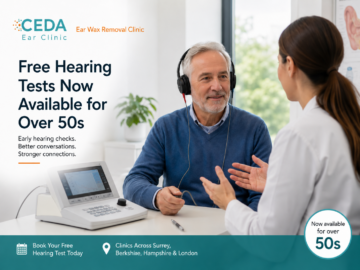
Our free hearing tests are now available to people aged 50 and over.
Previously offered to those aged 60 and above, we have expanded the service so that more people can understand their hearing sooner and take action if a problem is identified.
Whether you have started noticing changes or simply want a clearer understanding of your current hearing, a professional hearing assessment can provide useful answers.
Our experienced hearing professionals provide free hearing tests for over-50s at clinics across Surrey, Berkshire, Hampshire and London.
Hearing often changes gradually with age.
Age-related hearing loss, also known as presbycusis, develops because of changes within the inner ear over time. RNID describes it as the most common cause of hearing loss and notes that it often affects both ears.
Importantly, hearing difficulties are not limited to people in their 60s, 70s or 80s.
RNID’s latest UK prevalence information states that more than half of people aged 55 and over have hearing loss.
That does not mean everyone over 50 has a hearing problem.
It does mean that your 50s can be a sensible time to start paying closer attention to your hearing, particularly if you have noticed changes in conversations, television volume or your ability to hear clearly in background noise.
By reducing the eligibility age from 60 to 50, our aim is simple: make professional hearing assessment easier to access before hearing difficulties begin to significantly affect everyday life.
One of the difficulties with gradual hearing loss is that you may adapt without realising it.
Often, family members notice the change first.
According to the NHS and RNID, common signs of hearing loss can include:
You may recognise several of these signs, or perhaps only one.
The important point is not to guess.
A hearing test can establish whether your hearing is within the expected range or whether further assessment or support may be useful.
We routinely pay attention to other aspects of our health as we get older.
We have our eyesight checked. We monitor blood pressure. We attend health reviews when appropriate.
Hearing deserves the same attention.
A hearing assessment provides a useful picture of how well you are hearing sounds across different frequencies.
If your hearing is good, that can be reassuring.
If a change is identified, understanding it sooner gives you the opportunity to discuss what may be causing it and what options are available.
The NHS states that identifying hearing problems early is important so that they can be appropriately treated or managed.
The purpose of our free hearing test for over-50s is therefore not to assume something is wrong.
It is to give you clearer information about your hearing.
If you have never had a professional hearing test before, the process is much simpler than you may imagine.
A hearing assessment is non-invasive and is designed to establish how well you can hear different sounds.
Your appointment begins with a conversation about your hearing.
You may be asked whether you have noticed difficulty:
It is also useful to discuss any history of noise exposure, ear problems, tinnitus or other relevant medical information.
Before assessing your hearing, it is important to consider whether something within the ear canal may be affecting it.
One common cause of temporary hearing difficulty is ear wax build-up.
The NHS lists earwax as one of the possible causes of hearing loss and notes that treating an earwax blockage can sometimes resolve the underlying hearing difficulty.
As an established ear wax removal clinic, CEDA Ear Clinic can also assess wax-related concerns and offers professional microsuction ear wax removal where clinically appropriate.
During a typical hearing assessment, you may wear headphones and listen for sounds at different pitches and volumes.
You respond whenever you hear a sound.
This allows your hearing professional to determine the quietest sounds you can detect across a range of frequencies.
The NHS identifies pure tone audiometry as one of the standard hearing tests used with adults.
Depending on the assessment required, other hearing tests may also be used.
You should not leave your appointment staring at an incomprehensible graph.
Your results will be discussed with you so you understand what they mean.
If your hearing appears healthy, you can leave with reassurance and a useful reference point for the future.
If hearing loss is identified, your hearing professional can explain the findings and discuss appropriate next steps.
Possibly.
Ear wax is one of the more straightforward reasons why someone’s hearing may suddenly seem muffled or blocked.
Signs of an earwax blockage can include a blocked sensation, difficulty hearing and sometimes itching or discomfort.
This is one advantage of having your hearing assessed through a specialist ear clinic.
If excessive wax is interfering with your hearing or preventing proper examination of the ear, this can be identified.
CEDA Ear Clinic provides professional microsuction ear wax removal, with ear clinicians available across its clinic network.
However, you should never assume that all hearing loss is caused by wax.
If your hearing remains reduced after wax has been treated, the NHS recommends seeking further assessment.
Finding hearing loss does not automatically mean you need hearing aids.
The appropriate next step depends on the type and extent of the hearing change, your symptoms and how much it is affecting your everyday life.
If hearing support would be beneficial, the different options can be discussed with you.
CEDA Ear Clinic also supplies modern hearing aids, including options from Starkey and Phonak, where appropriate following assessment.
The important point is that the decision should follow your assessment.
Your hearing test is about understanding your hearing first.
You do not need to wait until conversations become extremely difficult before thinking about your hearing.
You may want to arrange an assessment because:
However, a routine clinic hearing assessment is not a substitute for urgent medical care when certain symptoms occur.
Some hearing changes should not wait for a routine appointment.
The NHS advises seeking urgent medical help if you experience:
Sudden or rapidly changing hearing loss can require prompt medical assessment.
If this happens, contact your GP urgently or NHS 111 rather than waiting for a routine hearing test.
Our free hearing tests for people aged 50 and over are available through our network of clinics across Surrey, Berkshire, Hampshire and London.
Current locations include:
This means professional hearing care is available locally without needing to travel to a central London clinic.
At CEDA Ear Clinic, hearing assessment forms part of a wider ear-care service.
Our clinics provide access to:
Understand whether your hearing has changed and what your results mean.
If excessive wax is contributing to blocked or reduced hearing, our clinicians provide microsuction ear wax removal where appropriate.
If permanent hearing loss is identified and hearing aids may help, suitable options can be discussed following assessment.
Our clinic network covers Surrey, Berkshire, Hampshire and London, making it easier to access professional ear and hearing care closer to home.
For patients who have difficulty attending a clinic, home hearing assessments and ear-care services may be available in selected areas.
Your hearing affects far more than how loudly you hear a sound.
It influences conversations with partners, children and grandchildren. It affects meetings, telephone calls, television, social occasions and the ability to follow what is happening around you.
Because hearing changes can happen gradually, it is easy to compensate without noticing how much has changed.
That is why we have expanded our free hearing-test service.
If you are aged 50 or over, you can now book a free hearing test with CEDA Ear Clinic.
You do not have to wait until your hearing becomes a major problem.
If everything is fine, you gain reassurance.
If something has changed, you gain information and the opportunity to understand your options.
Our free hearing tests are now available to everyone aged 50 and over, replacing our previous over-60s offer.
Appointments are available at participating CEDA Ear Clinic locations across Surrey, Berkshire, Hampshire and London.
Book your free hearing test today and take a simple step towards understanding your hearing better.
Telephone: 0300 124 7600
Yes. CEDA Ear Clinic now offers its free hearing-test service to eligible patients aged 50 and over. The previous eligibility age was 60.
Yes. The service has been expanded specifically so that people aged 50 to 59 can now access the free hearing test alongside those aged 60 and over.
The clinic’s service can be booked directly. You do not need to wait for a GP referral to arrange the clinic’s hearing assessment.
Hearing-test appointments vary depending on which assessments are needed. NHS guidance states that hearing tests can take approximately 15 minutes to one hour, depending on the tests performed.
No. Standard adult hearing assessments such as pure tone audiometry involve listening and responding to sounds and are non-invasive.
A significant wax blockage can affect hearing, which is why examining the ears forms an important part of assessing hearing difficulties. Earwax build-up is a recognised cause of temporary hearing loss.
No. Age alone does not mean that you have hearing loss. However, hearing loss becomes more common as we get older. RNID reports that more than half of people aged 55 and over have some degree of hearing loss.
Your results can be explained to you and appropriate next steps discussed. Depending on the cause and level of hearing loss, this could involve further assessment, managing ear wax where relevant or discussing hearing support such as hearing aids.
CEDA Ear Clinic currently has locations in West Byfleet, Sunningdale, Wokingham, Farnham, Reigate, Andover, Hampton Hill, Putney and Surbiton.